"You Can Have A Life You Love Wholeheartedly - Body And Soul."
William Wittmann, M.Ed., LMP
Craniosacral Therapy ~ A Healing Art
I have been practicing Craniosacral Therapy for nearly three decades, Ursula's article is best I have for explaining the mechanics of the work and the poetic heart of it. - William Wittmann, M.Ed., LMP
About 100 years ago William Sutherland, in his last year of studies to become a Doctor of Osteopathy, walked through the halls of the School of Osteopathy in Kirksville, Missouri. Suddenly he felt directed to the disarticulated bones he had passes many times without further notice. He felt transfixed by the articulation of the Sphenoid and the Temporal bone: “Then, like a blinding flash of light, came the thought: ‘Beveled, like the gills of a fish, and indicating articular mobility for respiratory mechanism.’” A man who had never heard inner voices before, was struck by this thought and spent the rest of his life exploring the movement of the bones of the skull. Sutherland did extensive studies and research, first on himself and then on his clients. He linked the movement of the bones at their sutures to the tidal flow of the cerebral spinal fluid (CSF). This fluid is a viscous liquid that surrounds the brain and the spinal cord, supplies the central nervous system with nutrients and cleanses it of waste. Using a football helmet to strap down individual cranial bones at a time, he realized that this would change his personality and sense of well-being. The force of the helmet inhibited the movement of an individual bone and thus decreased the space for the free flow of the CSF. His clients had similar restriction in movement of their cranial bones but due to past traumas in their lives, either physical or emotional. Sutherland found effective ways to work with these restrictions, focusing on the bones and the membrane system to increase the flow of the CSF. His clients enjoyed tremendous results from his treatments. Sutherland presented his findings and treatment work, now known as Cranio-sacral therapy, in the 1930’s to a very doubtful medical establishment.
Shortly before his death, Sutherland discovered a force from within the CSF that he called “The Breath of Life”. This discovery moved his work far beyond the physical approach into the realms of psyche and soul. Others call this “The Breath of Life” the soul, the genius, the Daimon. This work is as exciting and effective, as it is beyond manipulation, beyond adjustment, beyond force. It is all encompassing and it has been most rewarding for me to explore this little known path. Craniosacral work, when it is done on the path of Sutherland’s late findings, is one of the subtlest therapies. It offers a fantastic way to address the whole person. It holds many paradoxes true, for example: less is more and most subtle is most profound. This work can only be done by listening – listening to the quiet expression of the body, of its structure, its parts and components, and to the psyche and the soul.
Cranio-sacral therapy and techniques developed by Sutherland have found their way into the bodywork community, and rightly so. The tidal movement of the CFS affects the whole body, not just the bones. The tidal waves of the fluid ripple through every cell of the body. The movement of the fluid affects the cranial bones as well as every organ and limb, and can be felt on any part of the body. Likewise, the movement of the CSF is affected not only because of restrictions at the sutures, but also by muscle tension, enlarged blood vessels, and inflamed nerves. Because the tides of the CSF affect the entire body, it is arbitrary that craniosacral work comes out of Osteopathy, or should be linked exclusively to the bones.
The most important tool in cranial work is the cultivation of inner stillness by the practitioner. Only with inner stillness am I able to listen. Like in a conversation with a friend, if my mind is preoccupied with what I want to say next, or what I need to get at the grocery store, I am unable to hear what my friend wants to communicate. In cranial work my mind needs to be quiet so that I can listen with my hands, my ears, my whole body. I need to have the ability to come back to quiet when a thought distracts my present awareness. With a quiet mind I can be present, listen, and bear witness to what needs to be heard.
The second most important tool is my willingness to let go of any agenda, of a game plan, or a fixed set of techniques, so that I can be open to the uniqueness of each client. I call this going to a place of “not knowing”.
When I touch a client I do not know what I will find, I do not know what he/she needs, I do not know how they express health, and I do not know what needs to happen for them to feel more whole. Again, as in a conversation with a friend, if I think I know what she is saying before she opens her mouth, I am unlikely to really hear what she is saying. If I am able to stay in a place of not knowing, if I am able to truly let go of expectations and ideas, then I can hold a space for my client to express whatever needs to be expressed, verbally and nonverbally. This is difficult in a culture where education is based on knowledge and not on discovery. Our clients are often more than willing to give up the search for their own voice for professional answers that we offer. But a place of discovery, of “not knowing” releases me from the pressure to perform, to fix, or to cure – impossible tasks anyway.
Being open or accepting a place of “not knowing” does not give me permission to stay in oblivion, however. The more knowledge I bring to the work the less I need to hold on to it, and the easier it is for the practitioner to be in discovery mode. This is where bodywork becomes art.
The Body
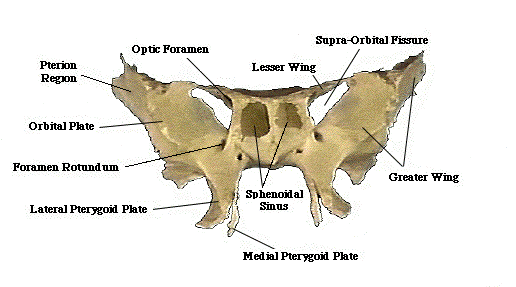
The body is the most material manifestation of our being. The first thing to learn in cranial work is to feel the cranial rhythm. One can listen to this wave for a long time, and do good work by just doing that. But it becomes a life-long goal to study anatomy and physiology in order to do this work masterfully. For example, the Sphenoid, called “the bone”, by Sutherland, is a beautiful structure that goes from one temple to the other, from the back of the mouth to the eye sockets. (The sphenoid is the bone at the beginning of the article. You can also see a wonderful three dimensional moving version here.) This bone’s anatomy is so intricate it can be studied over and over again. Then its connection to other bones through sutures and joints, through muscles and membranes become fascinations as do its relationship to the cranial nerves that run through and over it. Its influence on the endocrine system is an important consideration because the pituitary gland is nestled in the bone. The more I know about anatomy, physiology and pathology, the better I can focus on the various structures and listen. By listening with inner stillness, by putting my intention precisely on these structures, they start talking to me, expressing their discomfort, their compression or their happiness. They will also tell me what they need. And in my silent, skillful listening, the structures can find optimal positioning and functioning. This is not about manipulation because I, the practitioner, know what is best, this is about listening and allowing the body to find its own expression and its own movement. Who would want to be manipulated, anyway?
Continuous study is also important because science is nowhere near having full understanding of the body. Sutherland and others have developed techniques to work with the cranial bones and the sacrum in order to optimize the flow of the CSF. As the cranial bones are delicate and movements subtle, the correct positioning of my hands and fingers, as well as the weight I place on these bones, becomes very crucial. Throughout a treatment I need to have my full awareness on what my hands are doing. There are simple techniques that can be learned easily and applied readily. There are also more complicated, three-dimensional techniques that deal with more complex issues. And then there is intention, an even more powerful tool. I need to be aware of my intention and develop skillfulness and focus of it. Once I have learned and mastered the techniques, but only then, can I let go of their limitations and start improvising, just like any artist. Then, the possibilities become as wide as the sky, for you and your client!
Most trainings in this form of therapy only address the physical aspect of this work. However, I have come to realize that the most profound healing is done when the therapist can move beyond the physical.
The Psyche
The psyche deals with our emotions and to separate the body from the psyche is artificial. There is a psychic component to every physical experience, problem or trauma. It does not really matter which component is first or bigger. As health care professionals we are trained to work with the body, and often feel inadequate or scared to deal with the emotional aspect. It is good to know one’s limits. But when we start listening to the body it will not only tell us about the physical problem, but the pain of the psyche too. Sometimes the release of the pain does not come through the body, but through remembering the injury, the original hurt, that has happened to the psyche. The best way to study the psyche is to work with oneself, to discover all the human emotions in oneself, to go to the places of fear, anger, frustration, anguish and ecstasy in one’s own experience. If I have become familiar with the depth and the abyss of my own psyche, I can open myself to whatever my client is presenting. To become a psychotherapist, one of the most important teaching tools is to go through psychotherapy. To become a skillful cranial practitioner, it is very helpful to receive sessions and experience how this work touches one on many different levels.
This does not imply that the experiences of the clients are the same as mine. But I can follow fearlessly on the roads of someone if I have explored the ones of my own psyche.
The Soul
The place of the soul is where we feel at peace, where there is no blame and no guilt, no game, where a person experiences his or her life as meaningful, where everything makes sense, a place of innocence, of wonder and curiosity. It is beyond analytical understanding and speaks in stories – lyrical, archetypal, non-linear and symbolic. It is where we find ourselves in the right place at the right time, where our personal life experiences are connected to each other, where my experiences are connected to yours and to the world. Studying the soul, listening to the soul, and holding space for it to emerge is the most rewarding work I know. Cranial work with the body and psyche is a wonderful portal to the soul. If I show mastery of stillness, listening and respect at the portal, the soul might invite me to share its beautiful gardens.
Shamanism has always worked with the soul. Shamanistic tools like story telling or rituals are helpful in relating to the soul. Personally experiencing the effect of these tools as a way to explore my own soul is an excellent way to open myself up to relate to my client’s soul. It is very important to learn and use these tools from a place of humility. Humility guarantees that I will not violate my client’s soul by overpowering or hurting it. In our childhood our souls have learned to hide because of violation and carelessness. As practitioners, we invite the soul to come out of hiding.
One of my students used to say that to learn all this and to practice stillness, presence and bearing witness was a tall order. One can see it that way. But it is also very freeing. You study when it is time to study, you work when it is time to work, and do your best with being present, still, and unassuming with your clients. The rest one can leave to the angels, to the gods and goddesses, to your client, and to the natural tendency to move towards health. The practitioner can let go of fixing and curing, and experience surprise by what each client brings, and the results that come from your work together.
Ursula is one of my all time favorite teachers. She has practiced as a healer and teacher in the United States, Australia, and Switzerland for over 15 years. Ursula is excited to offer her own Cranio-Sacral Certification Program, which is based in Seattle, Washington.
You may contact her for details:Ursula Popp, L.A.c.,(206) 783-3922,
ursulampopp@aol.com